
Hormone Disruptors: Common Chemicals Affecting Women’s Health
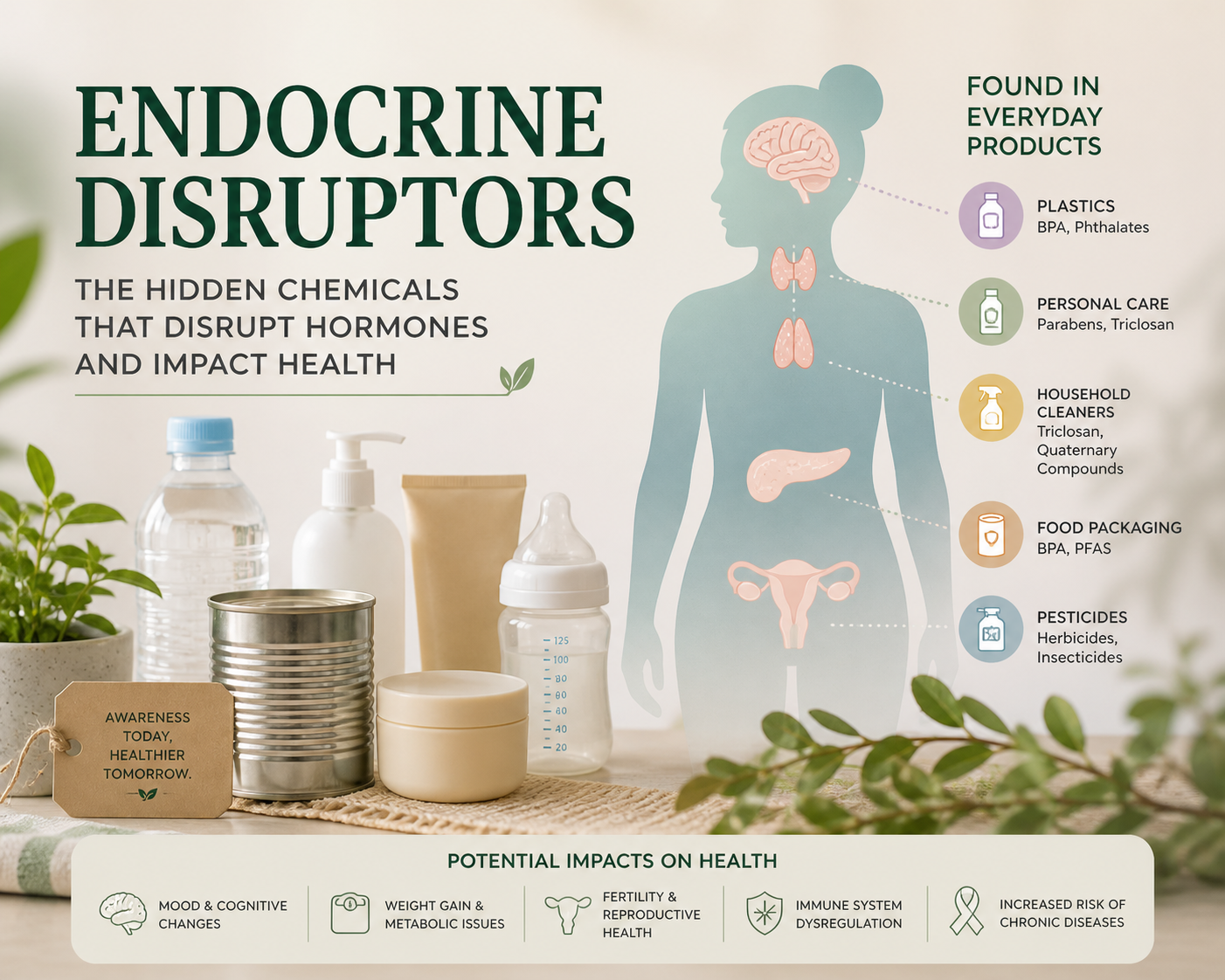
Common Endocrine-Disrupting Chemicals and Women’s Health
Why your hormones are under attack and what you can do about it
We often think of hormones as something internal, driven by age, stress, or genetics.
But one of the biggest influences on hormonal health today is external, invisible, and largely unrecognised: Endocrine-disrupting chemicals (EDCs).
These are compounds found in everyday products, from skincare and plastics to food packaging, that can interfere with the body’s hormonal signalling systems.
And for women, the consequences can be profound.
What Are Endocrine-Disrupting Chemicals?
EDCs are natural or man-made chemicals that mimic, block, or alter hormone function.
They are widely present in modern life and fall into several categories:
Industrial: dioxins, PCBs, alkylphenols
Agricultural: pesticides, herbicides, fungicides
Household / personal care: BPA, phthalates, parabens
Pharmaceutical-related: parabens and synthetic compounds
Heavy metals: lead, mercury, cadmium, arsenic
We are exposed daily through:
Food and water
Air (inhalation)
Skin contact (cosmetics, fragrances, lotions)
For many women, personal care products are a major and overlooked source of exposure.
Why This Matters for Women’s Health
Hormones operate in a finely tuned system. Even small disruptions can create ripple effects. Research has linked EDC exposure to:
Early puberty (menarche)
Irregular menstrual cycles
Polycystic ovary syndrome (PCOS)
Early menopause
Reduced fertility
Altered bone metabolism
Increased risk of breast and uterine cancers
This is not theoretical. It is increasingly clear that chronic, low-dose exposure over time plays a role in many of the hormonal issues women are now experiencing.
Could This Be Affecting You?
Many women are experiencing:
fatigue
PMS
irregular cycles
mood changes
weight fluctuations
perimenopausal symptoms
They are never encouraged to consider the role of environmental and hormonal stressors.
At Lantern Clinic, we take a more comprehensive, root-cause approach to women’s hormonal health.
For women wanting a deeper understanding of what may be driving their symptoms.
A Closer Look: Bisphenols
(BPA and Its “Replacements”)
One of the most studied EDCs is bisphenol A (BPA). It is used in:
Plastic containers
Food linings
Receipts
Cosmetics packaging
Over 95% of people have detectable BPA levels in their bodies. Even more concerning:
Low-dose exposure has been linked to endocrine disruption, reproductive issues, and tumour development
A 2023 study showed positive associations between BPA exposure and higher testosterone levels in women, as well as increased odds of PCOS
The effect was stronger in women with higher BMI, suggesting a metabolic-hormonal interaction
In response, manufacturers introduced “BPA-free” products.
However, these often contain BPS or BPF, structurally similar chemicals that may have similar endocrine-disrupting effects. Data suggests:
BPA detected in ~96% of samples
BPS in ~89%
BPF in ~66%
In other words: We didn’t remove the problem; we rebranded it!
The Hidden Source: Personal Care Products
Products marketed to women often contain:
Parabens (preservatives with oestrogen-like activity)
Phthalates (used in fragrances — rarely labelled clearly)
Benzophenones (UV filters in cosmetics)
Bisphenols (in packaging)
These are applied daily, directly to the skin, often multiple times per day. This creates a chronic, cumulative exposure that is rarely discussed in conventional care.
Why This Isn’t Being Addressed Properly
Traditional medicine tends to focus on:
Diagnosing disease
Prescribing treatment
But it rarely asks: “Why is this happening in the first place?”
EDCs represent a classic blind spot. Because:
Exposure is diffuse and cumulative
Effects are subtle and long-term
Testing is not routinely available or standardised
So the burden is often missed or ignored.
So the first step is not perfection, but awareness.
Small, intentional shifts, choosing glass over plastic, being more discerning with personal care products, and reducing reliance on highly processed foods, begin to reduce the overall load. Not dramatically overnight, but meaningfully over time.
Alongside this sits an equally important principle: the body’s innate ability to detoxify.
This is not a trend or a protocol. It is a core physiological function, one that depends heavily on nutritional status, gut health, hydration, and liver capacity. When these systems are supported, the body becomes more efficient at processing and eliminating unwanted compounds.
When they are overwhelmed or under-resourced, the burden accumulates.
This is why diet becomes central, not in a restrictive sense, but in a supportive one. Fibre, phytonutrients, and a diverse, whole-food intake all play a role in enhancing elimination pathways and reducing recirculation of toxins within the body.
And importantly, this process is never one-size-fits-all.
Each woman brings a different history, different exposures, different stressors, and different physiological resilience. Understanding those patterns allows for a more tailored, strategic approach, rather than a generic set of recommendations.
Because ultimately, this is not about avoiding everything.
It is about reducing what you can, supporting what matters, and allowing the body the space to function as it was designed to.
When Hormonal Symptoms Don’t Fully Make Sense
You may resonate with this article if you’ve experienced:
persistent fatigue
worsening PMS
painful or irregular cycles
mood fluctuations
unexplained weight changes
feeling “off” despite normal blood tests
Often, these symptoms are viewed separately. But sometimes, they are connected through deeper hormonal, metabolic, and environmental patterns.
Final Thought
This isn’t about fear or striving for perfection. It’s about awareness.
Once you recognise that your hormones are constantly responding to your environment, things begin to make sense. Symptoms feel less random, and patterns start to emerge.
From there, you have a choice: not to control everything, but to be more intentional about what matters.
Because real progress in women’s health comes not from doing more, but from understanding what is driving imbalance in the first place.
For women wanting a deeper understanding of symptoms such as fatigue, PMS, irregular cycles, PCOS, perimenopause, and hormonal imbalance.
